Dear Dr. Debbie,
I have a two-year-old girl and a four-year-old boy. They can generally play on their own for a while if I’m busy, but if one gets stuck with a problem I’ll try to solve it before frustration sets in. Because I’m taller and my memory is better, I can usually find the missing toy much faster than the little one can. Because I have decades of experience and pretty good manual dexterity, I can get a piece of tape to hold his paper sculpture together more securely than my older child can.
Is it better to let them struggle a bit before I rush in?
Am I a Helicopter?
Dear AIAH.,
If you pause to effectively “coach” a child, before frustration sets in, he has an opportunity to enjoy his own success. Children gain skills, including skills in problem solving, with years of practice, not with years of adults solving their problems for them.
Breaking Down the Process
You have long since mastered many of the challenges your children are just learning to cope with. You probably have developed automatic responses to such dilemmas as locating a missing item (including designating specific places to put things you’re not using), and making things balance (start on a flat surface and respect gravity).
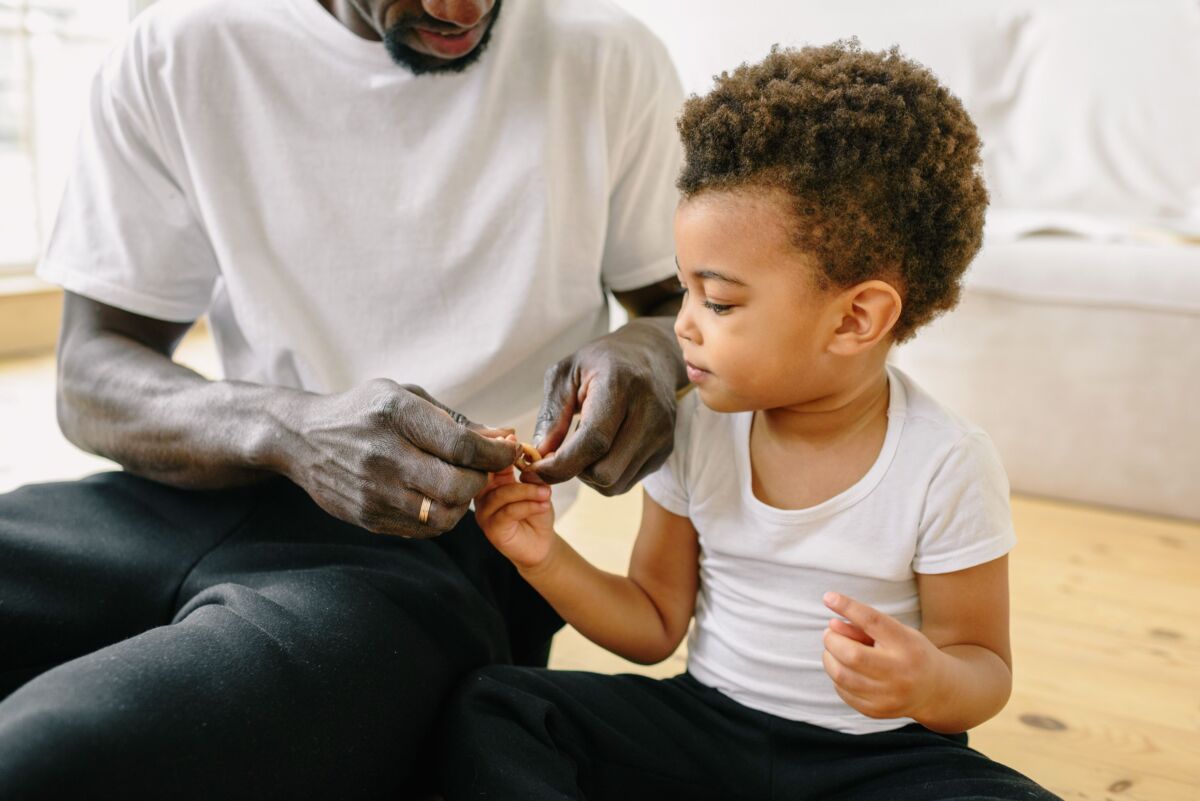
Try to support one step at a time as you coach a child through solving a problem. The first step is to identify that there is a problem. Use simple language to describe what the child is facing. “You don’t see the toy you’re looking for.” “The sculpture won’t stay up.”
Use, “I notice . . .” statements to get the child to direct his attention toward his own attempts at solving the problem. “I notice you’re looking through the toy box for it.” “I notice you keep adding pieces to one side of the sculpture.”
Good Questions
Lead a child to figuring things out on her own with some good questions.
For the missing toy, you can ask, “Where were you last using it?” or, “Is that usually an upstairs toy or a downstairs toy?” to help her close in on an area to search. Note, that for a two-year-old, a question with two options is easier for her to answer than an open-ended question.
Also, at age two, it’s hard for her to think of a moment that is not in the present, but your prompting may get her to picture herself in the place she was last playing with the toy (or where she often plays with it).
If the toy isn’t turning up fast enough, ask, “What do you need it for?”. Her answer could be followed by questions such as, “What else might work for that?” or “Is there something else you could do since you can’t find it right now?”
If the six-year-old seems to be struggling to make his paper sculpture stand up, ask, “What’s your plan here?” Then address the direction he hopes to go with, for example, “Would tape be helpful for that?” and let him decide if it would be. If he’s not yet well-coordinated with using tape, ask where he wants your hands to help. In other words, don’t take over. Take direction.
You could help your child learn to make a useful observation, such as “Which side is it leaning toward?” so he can work toward getting the sculpture more balanced. “Would some weight on this side help?” or “Would some support on the other side help?” or “Does one type of paper seem heavier than another kind?” If he dabbles in paper sculpting for a while, and encounters a similar challenge, ask, “What worked last time?”
As long as they’re not upset yet, a good line of questions supports the wheels turning in their brains.
Backing Off
Keep in mind that children have a strong motivation for independence. The paradox is they’ll whine and cry when they really need help because they’re upset that they need the help! Rather than reacting to the cranky tone, address the need being expressed. They want to succeed! (If a child is tired, hungry, or overly agitated, he may just need you to help him get a nap, a snack, or a pleasant diversion before returning to the problem.)
Be respectful of this natural drive for conquering their world. Instead of rushing in with a solution, stand by to support the child’s problem-solving process. As a child’s competence grows, a cool “I’m here if you need me” lets her know that you have confidence in her ability to handle the task at hand. After all, the end result of good parenting is to create an independent human being who can manage her own problems.
Unnecessary support robs a child of the opportunity to figure things out for herself.
Dr. Debbie
Write your question to Dr. Debbie! Please include age(s) of your child(ren) and other details about the situation or concern.
Deborah Wood, Ph.D. is a child development specialist and founding director of Chesapeake Children’s Museum, located at 25 Silopanna Road in Annapolis. Online reservations are available or call: 410-990-1993. Walk-ins are welcome. Fall Family Memberships to the museum provide unlimited admissions for your family through December 31, 2026.
There is a Nature Walk on Thursdays at 10:30 am. Art and Story Time with Mrs. Spears and Puppy the Puppet is on Mondays at 10:30 am.
Dr. Debbie has two parenting workshops coming up at the museum:
“I Had it First!”: Wednesday, October 21, 5:30-7:30 pm. You and your children will benefit from the conflict resolution skills taught in this workshop.
Little Kids at Hope,: Saturday, October 24, 9 am to 12 pm. Heighten your appreciation and skills for being a V.I.P. in the life of a young child.
Thanks to a grant from Anne Arundel County, the workshops are each $10 per person. Childcare professionals earn certificates approved by MSDE.